
August 13, 2025
How to Create a Calm Down Corner for Home or Classroom
Create a calm down corner for home or classroom with feelings posters, calming tools, and Montessori-inspired tips to help kids regulate emotions.
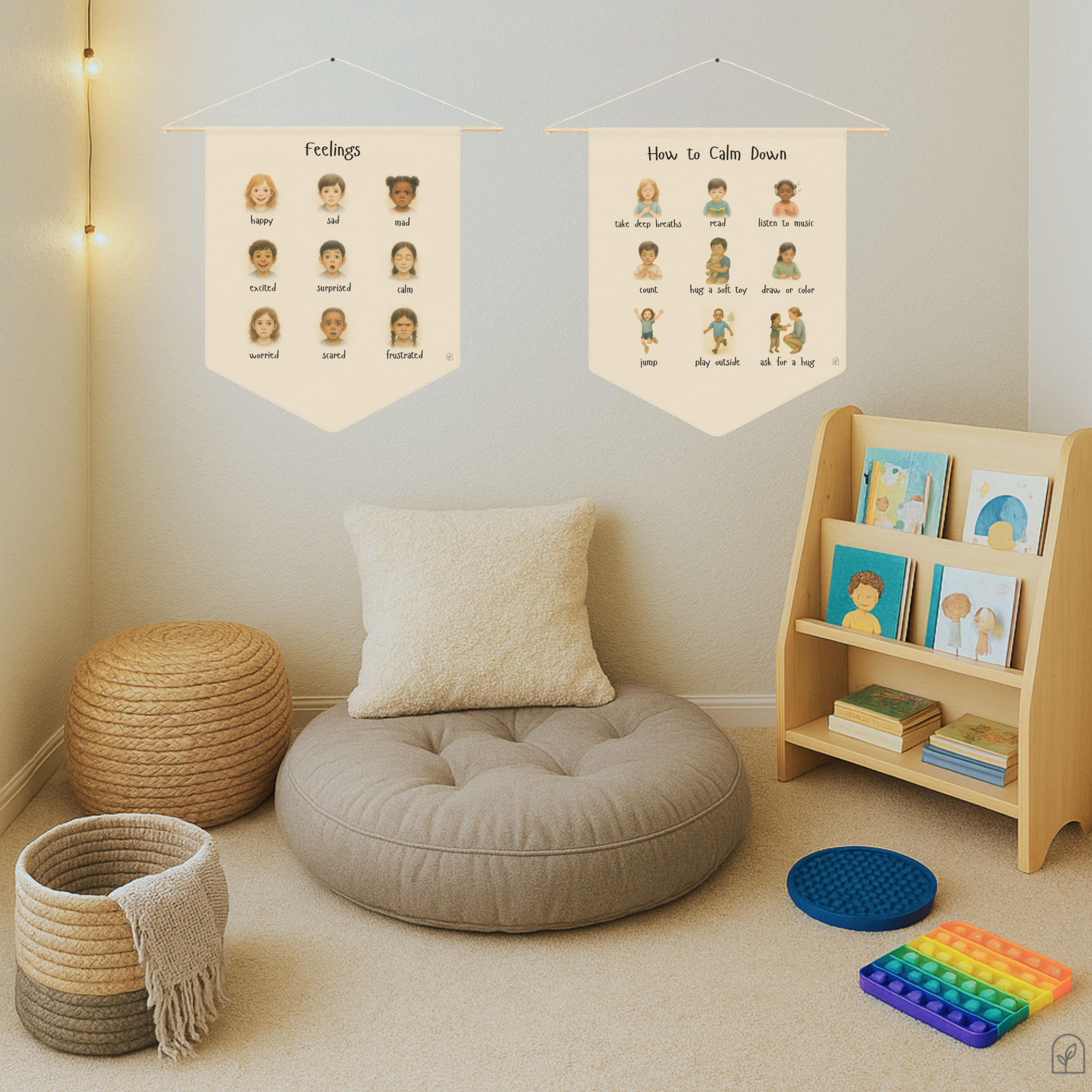
Big feelings are part of growing up - whether you’re a parent watching your toddler go from giggles to tears in minutes, or a teacher helping a student navigate frustration during a busy school day. One of the most effective tools I’ve found for helping children regulate emotions is a calm down corner — a dedicated space with visuals and tools to help kids name their feelings and choose healthy ways to calm down.
In this post, I’ll share how our calm down corner is set up, how our Feelings & How to Calm Down posters support emotional growth, and practical tips for creating one of your own — at home or in the classroom.
Why a Calm Down Corner Works Anywhere
A calm down corner is not about time-outs or punishment — it’s a safe, supportive space that says:
“Your feelings are valid, and you have tools to work through them.”
For children, it offers:
- A consistent place to go when they’re feeling overwhelmed
- Visual supports to identify emotions and calming strategies
- A chance to practice self-regulation in a positive, empowering way
At home, this might be a cozy nook in the living room or bedroom. In a classroom, a small section with soft seating and calming visuals works beautifully.
Our Calm Down Corner Setup
Here’s a look at what we use — adaptable for a family home or a classroom environment.
1. Feelings & How to Calm Down Posters
The heart of the space. Children point to the feelings chart to name their emotion (“I’m frustrated,” “I feel scared”), then use the calming strategies chart to choose what might help. Over time, this builds emotional vocabulary and real problem-solving skills.
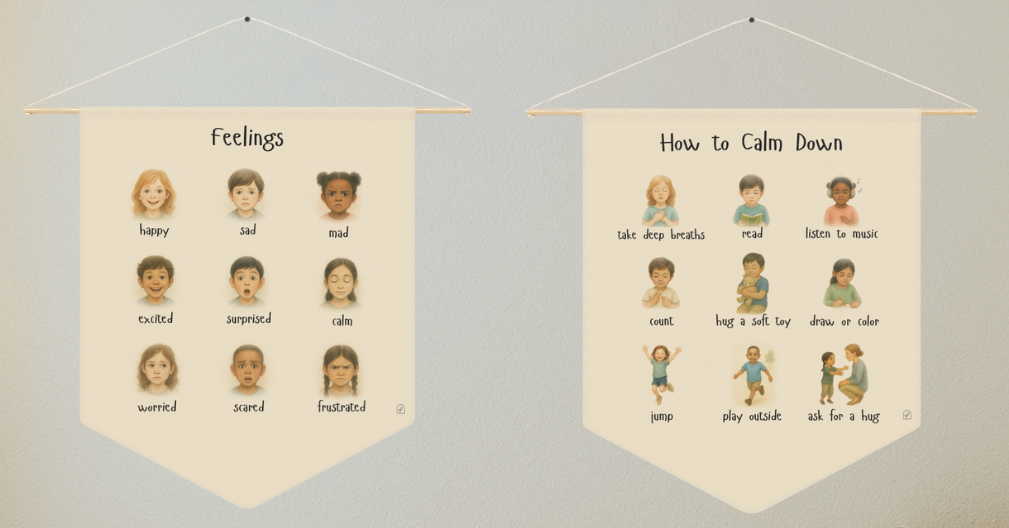
What makes these posters different is their soft, realistic artwork that reflects real-life children and situations — easier for little ones to connect with than cartoons. They use calming, muted colors so the space feels soothing rather than overstimulating, and they fit naturally in both homes and classrooms, from Montessori playrooms to early childhood learning spaces.
Over time, I’ve watched my toddler go from pointing at a “mad” face to independently choosing a strategy from the calming chart. That’s the real magic: giving children the tools to recognize what they’re feeling and decide what will help.
You can find the Feelings Poster Banner and How to Calm Down Poster Banner in my Etsy shop. I also offer matte and satin paper versions — Feelings Poster and How to Calm Down Poster — available in 15 sizes from 8”×8” up to 30”×40”.
2. A shelf or bin with calming tools
Our calm down corner includes a small shelf with tools that help children redirect their energy:
- Breathing ball (Hoberman sphere) — teaches deep, slow breaths in a visual, playful way
- Yoga cards — simple toddler-friendly poses that release tension and refocus the body
- Feelings figurines — small figures for acting out emotions and practicing empathy
- Books about emotions — rotating selections reinforce emotional literacy
- Mirror with interchangeable feelings cards — helps children connect internal feelings with what they see
3. A Cozy Spot to Sit
A calm down corner isn’t complete without a soft, inviting spot. We use a canopy hanging from the ceiling, a floor cushion, and a few pillows to make it feel like a special, safe place — not a corner of shame.
Tips for Setting Up Your Calm Down Corner
- Choose a low-traffic spot. A corner of the living room, bedroom, or classroom — somewhere the child feels contained and calm.
- Keep it simple. Start with the posters and one or two tools. A cluttered space is counterproductive.
- Involve your child. Let them help choose what goes in the space. Ownership increases buy-in.
- Introduce it during calm moments. Walk through how to use it when everyone is regulated — not mid-meltdown.
- Rotate items regularly. Fresh books and tools keep the space interesting.
What We’ve Seen in Action
The most powerful moment isn’t when I redirect my child to the corner — it’s when they go on their own. With consistent use, the calm down corner becomes a habit children reach for independently. That’s the goal.
Build Your Own Calm Down Corner
Ready to get started? Here’s what we use:
- Feelings Poster Banner — $29.99
- How to Calm Down Poster Banner — $29.99
- Feelings Poster (paper, 15 sizes) — from $13.11
- Calming Techniques Poster (paper) — from $13.11
Shop the tools mentioned in this post
Find our Feelings and Calming posters, name workbooks, and more.
Browse the Shop →